Give the beans
a little time.
Understand coffee degassing, why some beans benefit from rest, and how to find a useful resting period through repeatable tasting.
Pour a cup. Settle in.
What resting actually means
Roasting creates gases within coffee beans, including carbon dioxide. Those gases leave the coffee over time. Resting means allowing some time after roasting before brewing, with the aim of reaching a brewing behavior and flavor you prefer.
It is not a separate treatment that guarantees sweetness. It is a practical response to an ingredient that is changing. The Specialty Coffee Association’s freshness material and Samo Smrke’s science discussion explain why degassing belongs in a broader picture that also includes aroma loss and storage.
Your task at home is simpler: keep dates, use a repeatable recipe, and notice when the coffee becomes enjoyable and predictable with your equipment.
Why one waiting period does not fit every bag
Roast style, bean structure, packaging, and storage influence the way coffee changes. Espresso and filter preparation also interact differently with the coffee. A recommendation that works for one light roast and one method should not become a compulsory rule for all beans.
Ask the roaster for a suggested starting window when available. Then record what happens in your own kitchen. If a coffee tastes good earlier than expected, that preference is useful. If it improves later, keep that observation too.
Avoid using bloom size or crema volume as your only evidence. They can tell you something about brewing behavior, but the cup still needs to be tasted. A dramatic extraction can be less balanced than a quieter-looking one.
Know your beans.
Enjoy their story.
Keep a coffee bean shelf with roast context, freshness references, and linked brewing records in BrewTrax.
Explore Coffee Bean Inventory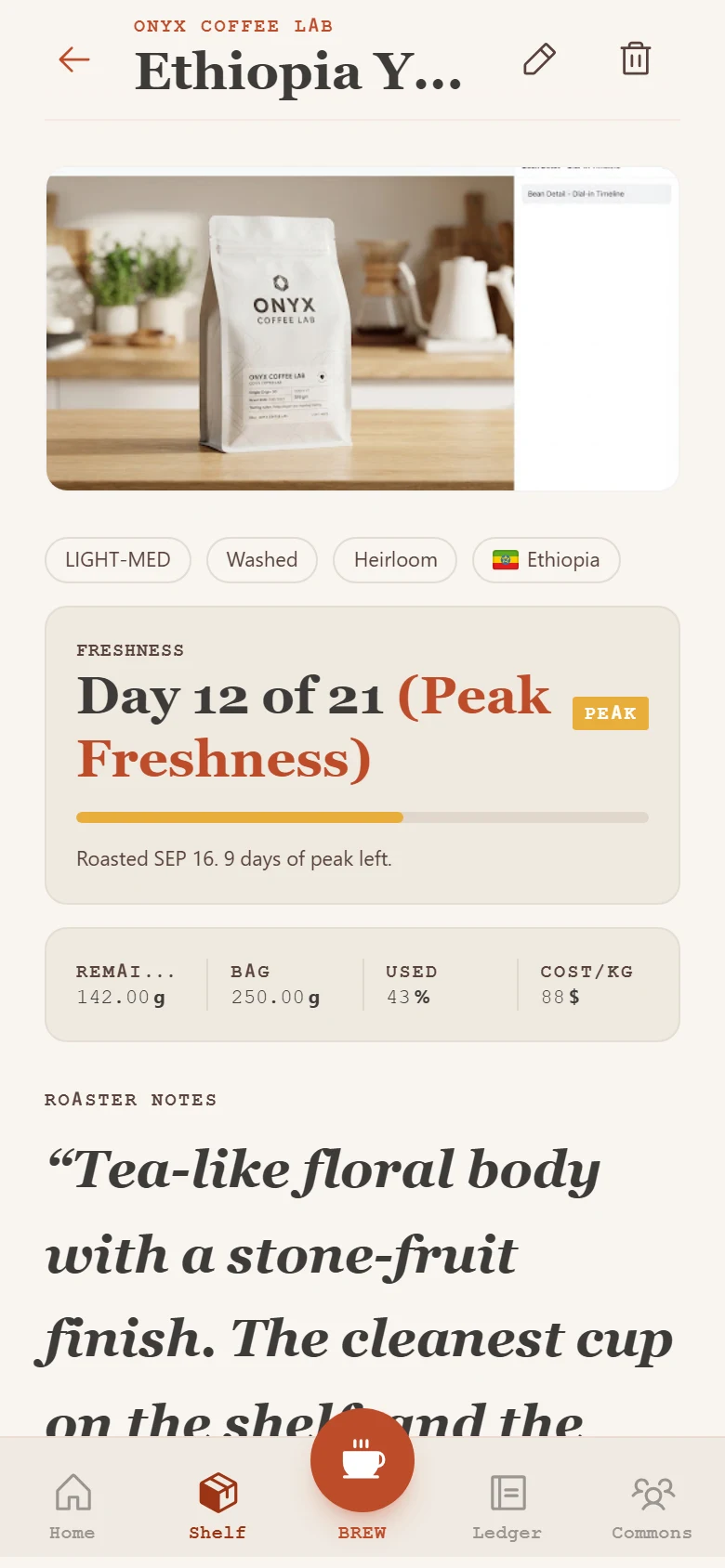
REMEMBER THE CUP.
Taste a progression instead of waiting blindly
Choose a small set of tasting days that fits the amount of coffee you have. Use the same dose, ratio, water source, and equipment, and preserve the storage conditions. Write the roast age beside each entry.
You do not need to brew every day or waste several doses in a single session. Three or four well-described observations can be more useful than a calendar full of rushed scores. If you adjust the recipe between observations, mark the adjustment so the timeline does not imply age was the only variable.
Include a short process note: bloom behavior, espresso flow, or drawdown. Then add the flavor result at a comparable temperature.
| Track | What it tells you |
|---|---|
| Before the first brew | Roast date, roaster guidance, storage |
| Each tasting day | Actual roast age and a stable recipe |
| Process | Any noticeable flow or gas-related behavior |
| Cup | Sweetness, aroma, body, and finish |
| Conclusion | The window you preferred for this bag |
Resting and storage work together
Time is not the only factor. A bag repeatedly exposed to air, heat, or moisture is not undergoing the same experience as a well-stored package. Follow the packaging and roaster’s guidance and keep the conditions consistent while learning.
Do not leave coffee open deliberately to “speed up” resting without understanding that you are changing exposure as well as time. A journal experiment becomes harder to interpret when its storage changes halfway through.
In BrewTrax, the bean record and brew history let you read the progression together. Save your preferred recipe and the age at which you enjoyed it. Use that as a starting expectation for the next bag from the same roaster, while allowing the next coffee to tell its own story.