Taste. Adjust.
Keep the reasoning.
Learn from Lance Hedrick’s original pour-over and dialing-in videos, then use a brew journal to preserve your baseline and adjustments.
Pour a cup. Settle in.
Watch decisions, not just recipes
In “My Secrets to Dialing In Pourovers,” Lance Hedrick works through six different coffees. The video’s structure makes it a useful starting point for thinking about adaptation: different beans are approached as distinct brewing problems rather than forced into an identical final setting.
The chapter titled “Stick to What You Know,” beginning around 1:35, is a good place to start watching. The first coffee segment begins around 4:30, and the final thoughts around 45:50. Use the original demonstration for the actual decisions and tasting discussion rather than relying on a quote stripped of its context.
For a journal, the useful idea is to preserve both the familiar baseline and the reason for departing from it. “Changed grind” is a record of an action. “Changed grind because the previous cup felt thin, then compared sweetness as it cooled” is a record you can learn from.
Understand the range in the written recipe
Hedrick’s separate “Ultimate Pourover Recipe” description provides a flexible framework rather than a single setting for every coffee. It describes a medium grind, up to 30 g of coffee, a ratio range of 1:14–1:17, and water from 85–100°C depending on the coffee’s roast context.
The description uses a bloom around three times the coffee mass, with agitation and a one-to-two-minute wait, then a main pour around 6–8 g per second. It discusses further bed handling in relation to drainage. Those details belong together as a method; selecting one number without the surrounding technique changes the recipe.
If you use this framework, choose and record actual values before brewing. A saved entry saying “85–100°C” does not tell tomorrow’s brewer what you did today.
| Source framework | What your entry should say |
|---|---|
| Ratio range | The dose and water you actually used |
| Temperature range | Your chosen temperature and coffee context |
| Bloom duration range | Your actual wait |
| Pouring-rate guidance | Your target and any obvious execution difference |
| Drainage response | Which movement you used, when, and why |
Discover your taste.
One cup at a time.
Capture coffee ratings, sensory notes, and brewing patterns with BrewTrax tasting records and personal insights.
Explore Coffee Tasting Notes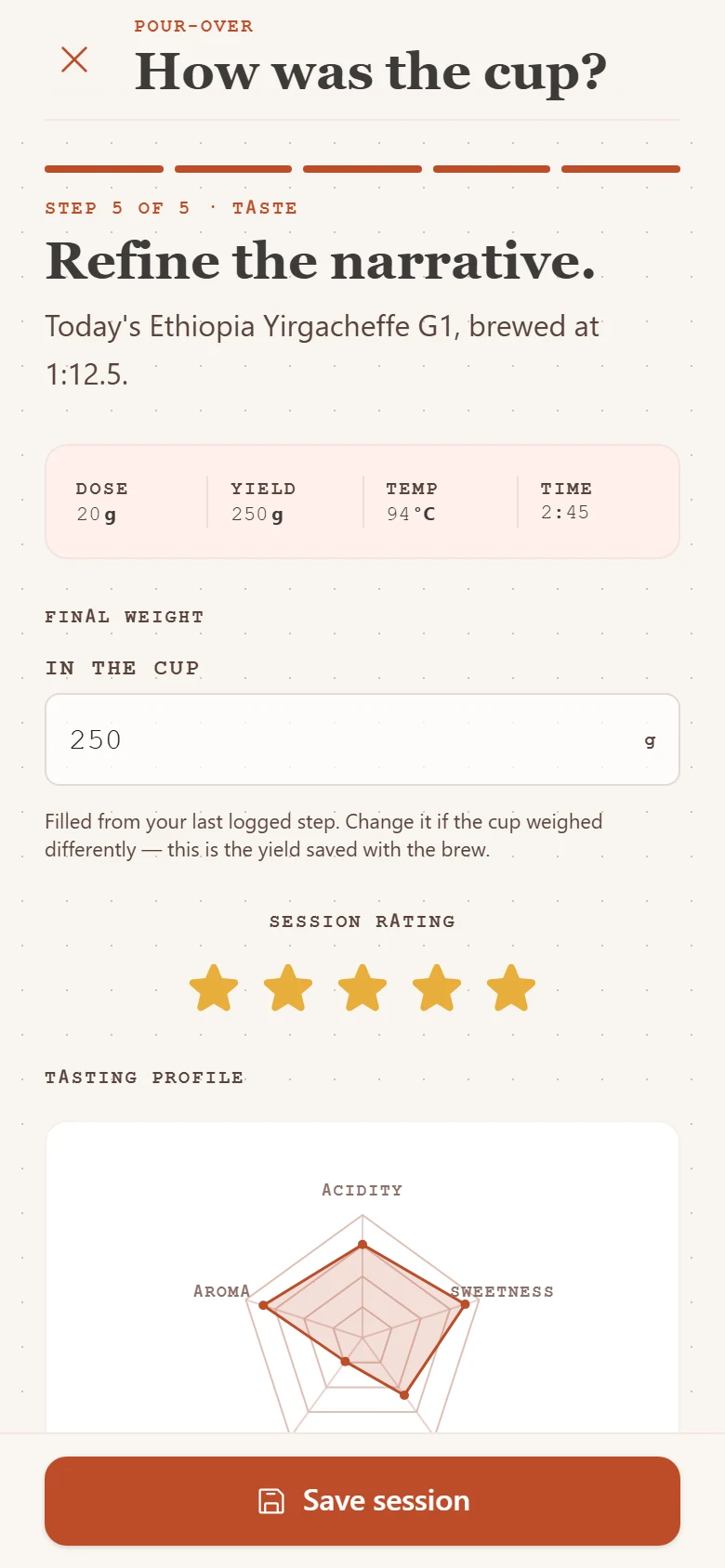
REMEMBER THE CUP.
Separate the source from your experiment
Keep the original link in your recipe notes. Then label your own adaptation: different brewer, dose, grind, or water. This makes the source useful without pretending your cup exactly reproduces the creator’s setup.
Do not turn a broad recipe range into a rule that every light roast or every dark roast must follow. It offers a starting framework. Your particular coffee, equipment, and preferences still need observation.
When writing the outcome, start with what you tasted. Add your explanation as a hypothesis, then choose a next test. This keeps the journal honest when an expected improvement does not appear. A record of changed reasoning can be as valuable as a record of changed grind.
Keep a familiar baseline close
Choose one repeatable pour-over routine and use it across a small set of coffees. Record where it works well and where you adapt it. After several entries, you may see which adjustments are useful for your equipment and taste.
BrewTrax’s ledger and tasting records give those experiments continuity. Save the successful cup, but retain the attempts that led there. Comparing them can be more instructive than looking only at favorites.
The connection to the videos is educational: the original demonstrations invite attention to coffee and technique. Your journal carries that attention into the next morning, when you have a different bag, your own grinder, and a cup to make.