Change one thing.
Learn a little more.
A practical coffee dialing-in workflow: establish a baseline, describe taste, adjust one variable, and confirm the result.
Pour a cup. Settle in.
Start with a recipe you can repeat
Dialing in is the process of adapting a recipe to a coffee and your taste. It works best when the baseline is clear. Choose a dose that suits your brewer, a sensible ratio, and a familiar preparation routine. Save them before changing anything.
A baseline is not a claim that this recipe is ideal. It is a reference that makes the next cup informative. If your dose, water, temperature, and pouring pattern drift together, an improved taste will be difficult to explain. That does not make the cup less enjoyable; it makes the experiment less clear.
Use the same water source and filter while comparing nearby recipes. Record the coffee’s roast and opening dates if known. These details help explain why last week’s successful recipe may behave differently today.
Describe the problem before choosing the fix
Taste the cup at more than one temperature. Very hot coffee can conceal differences that become obvious as it cools. Ask whether the cup feels weak or intense, balanced or harsh, clean or drying. Choose the quality you most want to change.
Sourness does not automatically prove under-extraction, and bitterness does not automatically prove over-extraction. The coffee’s own character, roast, water, and uneven brewing complicate those labels. The Coffee Compass and Espresso Compass offer useful frameworks, but your note should begin with the sensation you experienced.
“Thin, with a short finish” is a better observation than “bad.” “Dry after swallowing, although sweet at first” is more useful than a score alone. Those descriptions help you decide whether to explore concentration, extraction, or preparation consistency.
Separate observation from explanation
Observation: “The finish feels drying.” Hypothesis: “My final swirl may be too aggressive.” Next test: “Keep the recipe steady and use a gentler swirl.”
Discover your taste.
One cup at a time.
Capture coffee ratings, sensory notes, and brewing patterns with BrewTrax tasting records and personal insights.
Explore Coffee Tasting Notes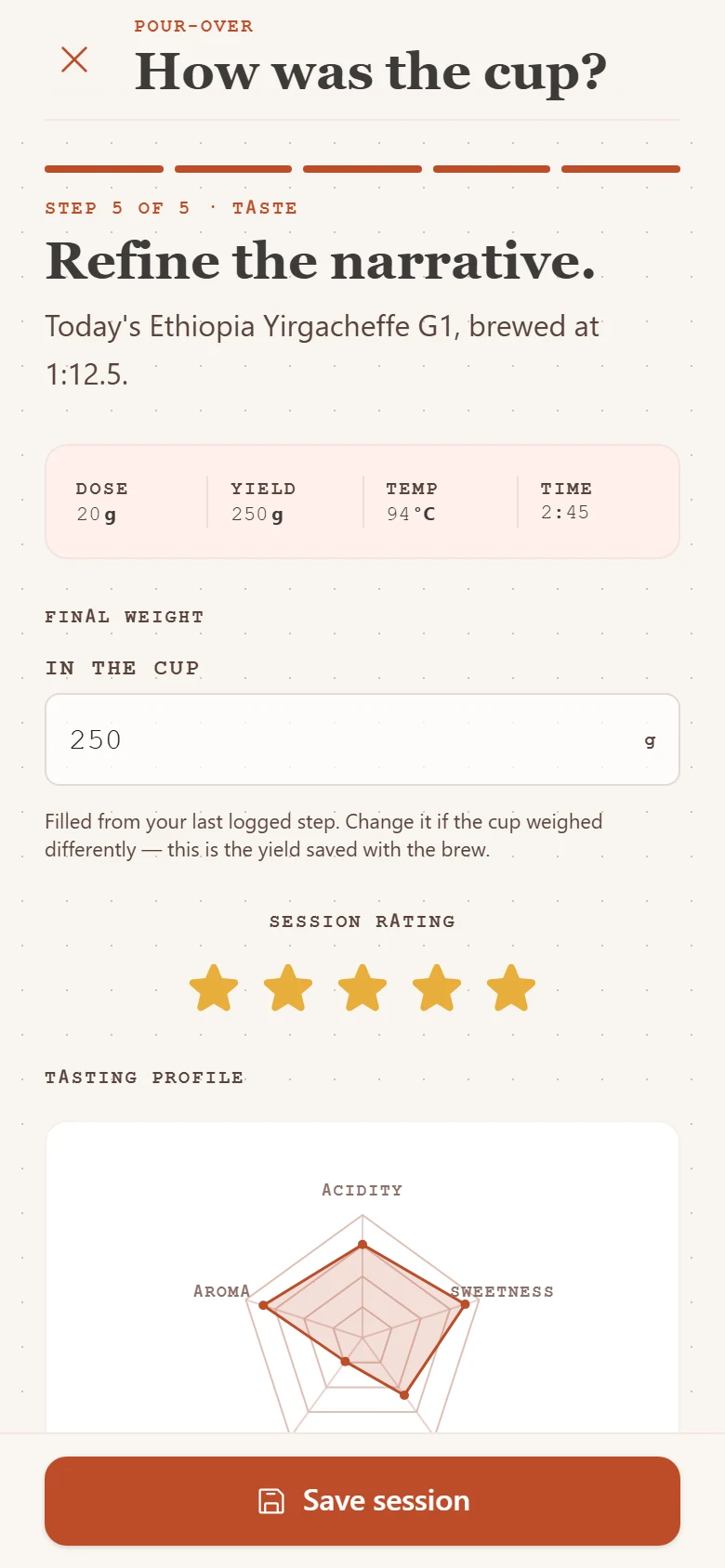
REMEMBER THE CUP.
Make a change you can name
Select one deliberate adjustment. For pour-over, that might be a small grind change while retaining dose, water, temperature, and pour schedule. For espresso, you might hold dose and grind steady while changing target yield. The choice depends on the problem.
Write your prediction before tasting, then record the outcome honestly, including when it does not match. A failed prediction is useful because it tells you to revisit your explanation. Avoid rewriting yesterday’s note to make today’s result seem inevitable.
Some variables cannot be isolated perfectly at home. A grind change can also change drawdown; a larger dose changes bed depth. Record these consequences rather than pretending the experiment is laboratory-controlled.
| Keep steady | Change | Observe |
|---|---|---|
| Coffee, dose, water, pours | One grind increment | Flow, sweetness, finish |
| Espresso dose and grind | Target yield | Balance and concentration |
| Pour-over recipe and grind | Gentler agitation | Drawdown and dryness |
Repeat the winner before moving on
One excellent cup is a promising result. A second similar cup gives you more confidence that you can reproduce it. Repeat the preferred recipe before making another adjustment, particularly if the previous difference was subtle.
If the repeated cup disappoints, look for execution differences: uneven wetting, a filter fold, puck preparation, or an accidental overshoot. You may need a more stable routine rather than a new recipe.
BrewTrax puts recipes, tasting notes, and brewing history together so you can compare intention with outcome. Mark a favorite when you find it, but keep earlier attempts. They explain how you arrived there and give you a recovery point when the next bag behaves differently.
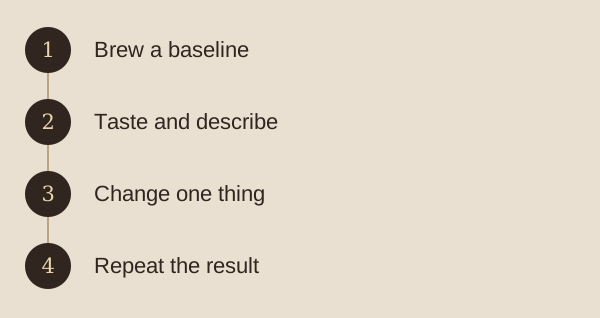
- Save a baseline.
- Describe one thing to improve.
- Choose one adjustment.
- Taste again as the cup cools.
- Repeat the better result.