A thoughtful split.
A deliberate pour.
Understand the 4:6 water split using HARIO’s published Tetsu Kasuya recipe, with five pour targets and a practical tracking guide.
Pour a cup. Settle in.
4:6 describes the water, not the pour count
The name refers to dividing the total brewing water into an initial 40 percent and a remaining 60 percent. It does not mean four pours followed by six pours, and it does not mean the entire recipe has four additions.
HARIO’s published recipe with Tetsu Kasuya uses 20 g of coffee and 300 mL of water, a coarse grind, and water at 92°C. Its first two pours total 120 mL, which is 40 percent of 300. The remaining three additions total 180 mL.
Kasuya presents the split as a way to think about flavor balance and strength. Treat that as the creator’s recipe framework, then test your own result. It is more useful to understand the actual schedule than to assume each adjustment guarantees the same sensory outcome for every coffee.
The HARIO example, written as targets
The source expresses water in milliliters. For a practical scale-based brewing log, the targets below use approximately equivalent gram readings. Preserve the source convention in your recipe notes if exact attribution matters.
Start timing with the first addition. Record your real grinder setting alongside the source’s coarse-grind description. The reference gives you a direction, not a universal click number.
| Stage | Start | Addition | Cumulative target |
|---|---|---|---|
| First | 0:00 | 50 | 50 |
| Second | 0:45 | 70 | 120 |
| Third | 1:30 | 60 | 180 |
| Fourth | 2:10 | 60 | 240 |
| Fifth | 2:40 | 60 | 300 |
Follow the ritual.
Keep the details.
Bring structure to your coffee routine with BrewTrax method selection, recipe setup, brewing timers, and recorded steps.
Explore Guided Coffee Brewing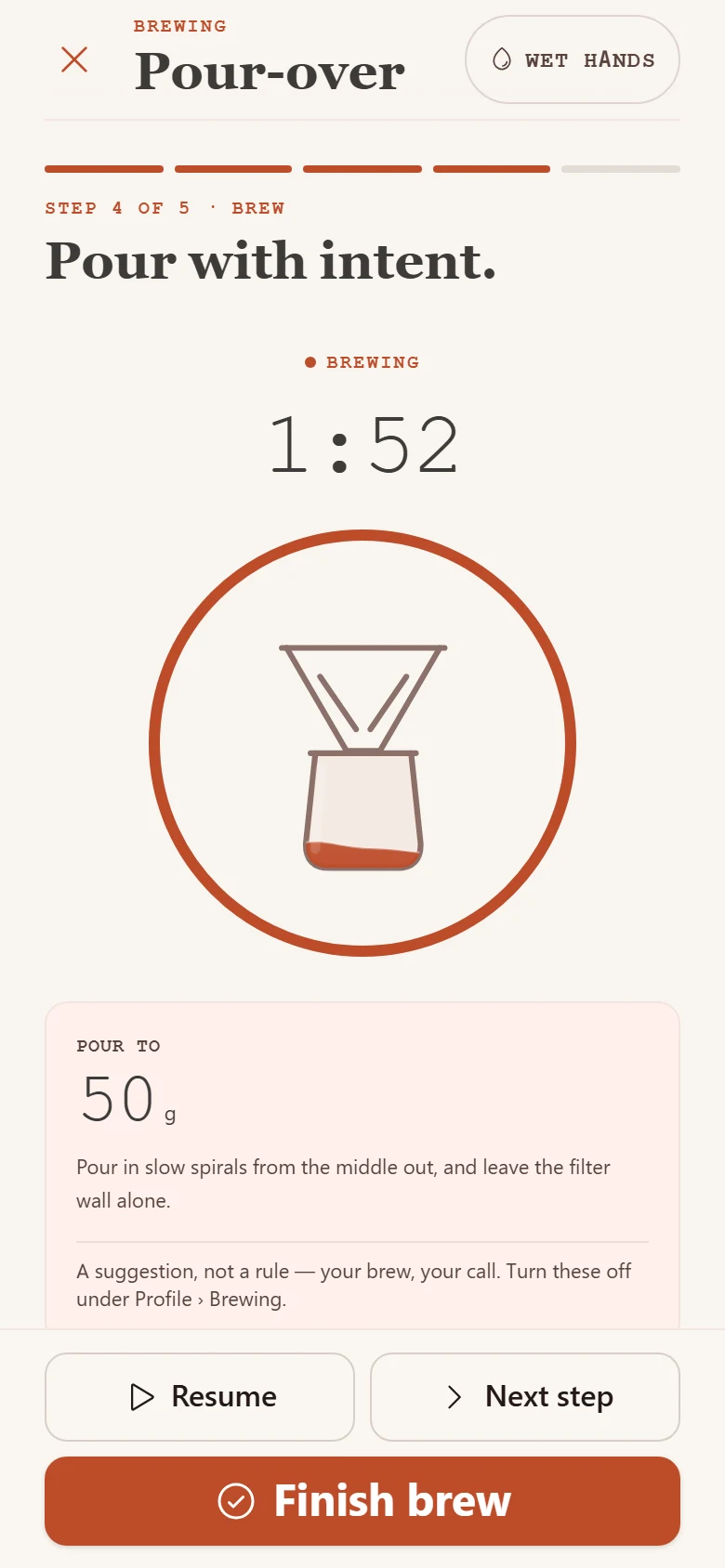
REMEMBER THE CUP.
Track the split and the flow
HARIO’s example lists a final time around 3:30. Use that as part of the reference recipe, not a pass-or-fail test. Your filter, grinder, coffee, and pouring can move the finish time. Taste before deciding a difference is a problem.
Write down whether the bed drains between additions and how strongly you agitate it. Two brews can use identical targets but differ in kettle height, pour duration, or swirling. Those details explain why a copied schedule may not taste like your expectation.
If you adjust the first two additions, keep their combined amount clear. For this 300 g example, they still total 120 g if you are preserving the original 40 percent split. Changing the overall total at the same time makes the comparison harder to understand.
Make one version your baseline
First brew the published example as closely as your equipment permits. Record any necessary adaptation openly. Then taste and decide what you want to explore: the early water distribution, the later pulses, or the grind.
Avoid changing all three together. A successful cup is still enjoyable, but you will not know which part of the adjustment contributed. Repeating the baseline gives you a much stronger reference.
BrewTrax can preserve each pour as part of the saved method, with your coffee and tasting notes attached. Label the recipe “4:6 — HARIO example, adapted for my grinder” so the original and your version remain distinguishable.
If you are curious about Kasuya’s newer ten-pour approach, read it as a separate recipe. It uses a different pulse structure and coarse-grind starting point, not simply an extra set of pours added to this one.