A little maths.
A clearer cup.
Understand filter coffee ratios, espresso yield, and cold-brew dilution with worked examples and a practical ratio calculator.
Pour a cup. Settle in.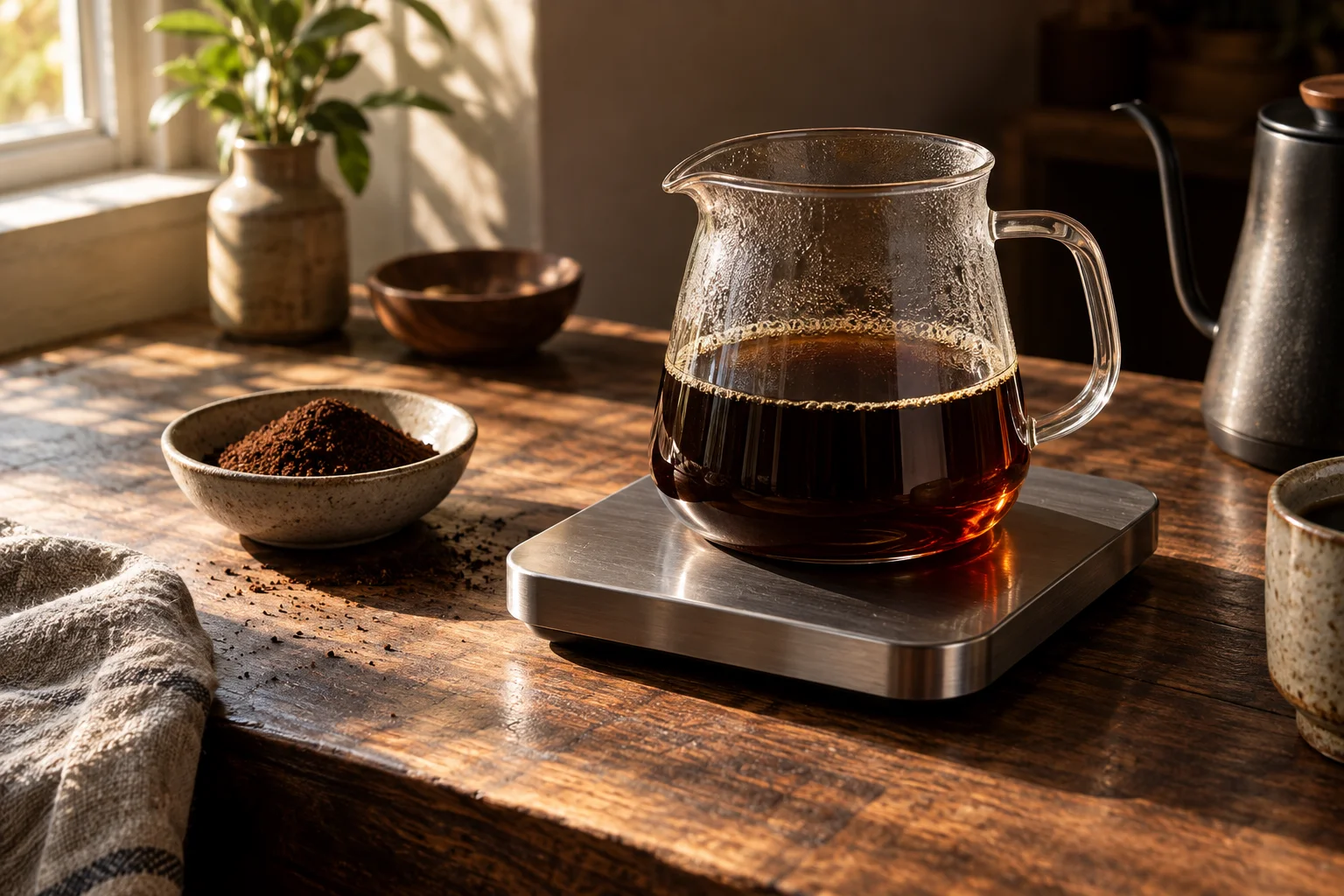
What does 1:16 actually mean?
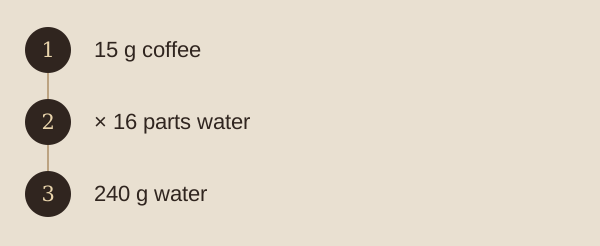
A brew ratio describes a relationship between two masses. For filter coffee, 1:16 usually means one gram of dry coffee for every sixteen grams of brewing water. A 15 g dose therefore calls for 240 g of water. At 1:17, the same dose uses 255 g. State what you measured, because the numbers alone do not identify the recipe.
Weigh water added to a pour-over, not the finished drink left in the carafe. Some water remains in the grounds and filter. You will not receive 250 g of beverage simply because you poured 250 g onto the coffee.
Ratios help you scale a recipe and describe concentration choices. They do not guarantee a particular taste. Grind, temperature, water chemistry, brewer geometry, agitation, and coffee all affect the result. Use a ratio as a starting coordinate, then use taste to decide where to go.
Calculate the number you need
Multiply your coffee dose by the second number in the ratio to find brewing water. Divide your intended water by that number to find coffee dose. If you want 300 g of water at 1:15, divide 300 by 15: you need 20 g of coffee.
Scaling is arithmetic; brewing is physical. A 30 g V60 bed is deeper than a 15 g bed. It may drain differently even at the same ratio. When making a larger batch, preserve the ratio first, then observe flow and taste before assuming the original grind and timings still apply.
| Recipe | Calculation | Result |
|---|---|---|
| Filter, 15 g at 1:16 | 15 × 16 | 240 g brewing water |
| Filter, 300 g at 1:15 | 300 ÷ 15 | 20 g dry coffee |
| Espresso, 18 g at 1:2 | 18 × 2 | 36 g beverage yield |
A little help with the numbers.
For filter coffee: dry coffee × ratio = input water. Espresso uses beverage yield instead.
Follow the ritual.
Keep the details.
Bring structure to your coffee routine with BrewTrax method selection, recipe setup, brewing timers, and recorded steps.
Explore Guided Coffee Brewing
REMEMBER THE CUP.
Espresso uses beverage yield
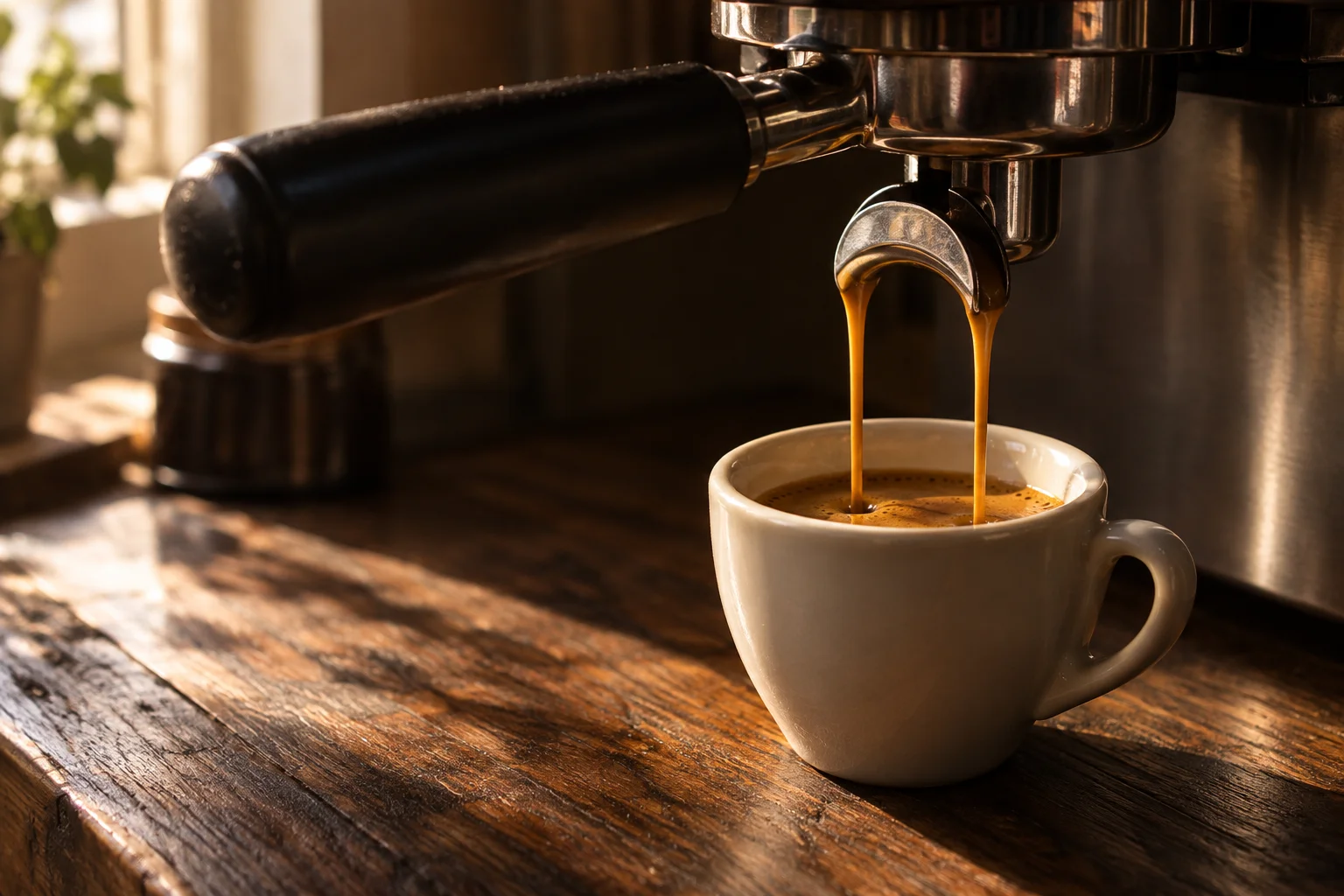
For espresso, a stated 1:2 commonly means dry coffee to liquid espresso in the cup. An 18 g dose producing 36 g of espresso is a 1:2 shot. It does not mean that only 36 g of water passed into the machine’s brewing system.
This distinction matters when you log different methods together. Record espresso dose, output yield, grind, and time. For pour-over, record dose, input water, grind, and timing. Label milk or added water separately: an Americano made with a 36 g espresso plus water is still built from that espresso recipe.
Changing espresso yield changes more than drink size. A longer shot often changes both concentration and extraction. The Espresso Compass from Barista Hustle is useful for thinking about these two axes. A concentrated shot can still be unbalanced.
Keep dilution separate
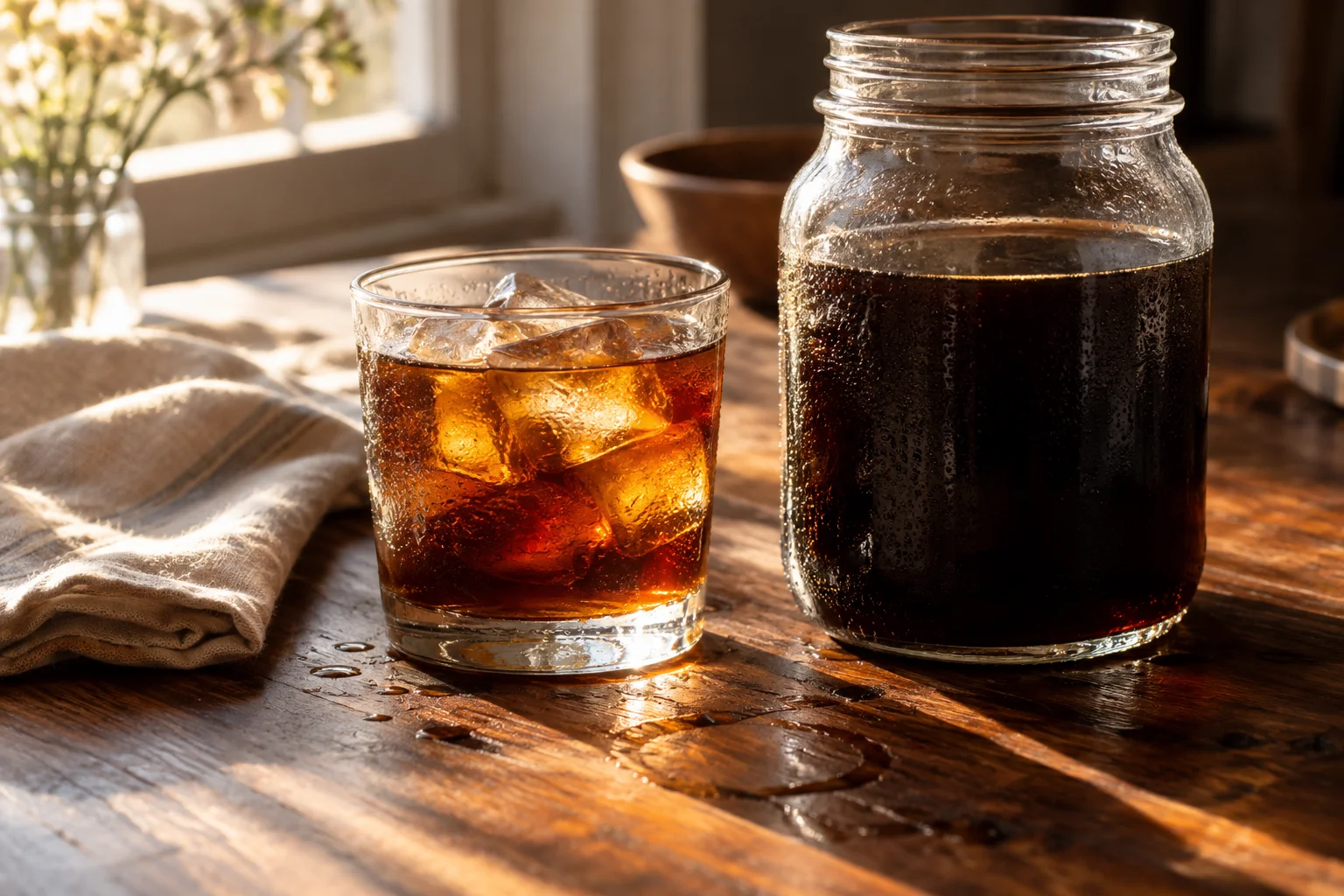
Cold brew is often prepared as a concentrate and diluted later. The ratio in the brewing vessel and the ratio in the glass describe different stages. Write both. For example, 100 g of finished concentrate plus 200 g of water is a 1:2 concentrate-to-water dilution. It says nothing by itself about the original coffee dose.
Ice is another source of water. If you brew directly over ice, record both the hot water poured through the grounds and the ice in the receiving vessel. “250 g water” is ambiguous if 100 g of it was ice bypassing the coffee bed.
When tasting an adjustment, ask whether you want a different concentration, a different extraction, or both. BrewTrax keeps method and recipe context beside your notes so an attractive number never has to stand alone.
A useful next experiment
Keep coffee, grind, brewer, and pouring pattern steady. Compare two nearby water ratios. Record which cup you prefer as it cools, then repeat the preferred recipe before changing something else.